

Nov 26, 2026 Circulatory problems after a spinal cord injury: how movement can help

Back to Blog Overview
Feeling dizzy when you sit up, low blood pressure, even fainting: for many people with a spinal cord injury, circulation problems are part of daily life. A spinal cord injury doesn't only affect movement and sensation. It can also disrupt how the body controls the heart and blood vessels.
In this article you can read about:
- why circulation problems happen after a spinal cord injury
- what orthostatic hypotension and autonomic dysreflexia are
- how circulation problems affect daily life
- why regular movement matters for the heart and circulation
- which types of training can help keep blood pressure stable
- how dynamic standing with the Innowalk can support circulation
- what people in our Spinal Cord Injury Expert Round Table say about training with the Innowalk
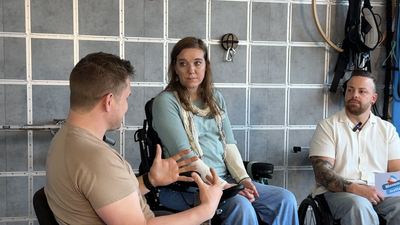
We discussed these questions in our Spinal Cord Injury Expert Round Table with people living with a spinal cord injury and an experienced physiotherapist.
Why do circulation problems happen after a spinal cord injury?
The autonomic nervous system controls many of the body's automatic functions, including blood pressure, heart rate and the widening and narrowing of blood vessels. A spinal cord injury can interrupt the signals between the brain and the body, so these systems no longer work properly.
People with an injury in the neck (cervical spine) or upper back (upper thoracic spine) are most likely to have problems controlling their blood pressure. Paralysis also means the leg muscles can no longer work fully, or at all, as a "muscle pump". Normally, every time the leg muscles contract, they help push blood from the legs back to the heart. Without this, blood can pool in the legs and lower body, especially when sitting up or standing.
Orthostatic hypotension: when blood pressure drops as you sit or stand up
One of the most common circulation problems after a spinal cord injury is orthostatic hypotension. This is a drop in blood pressure when moving from lying or sitting to an upright position.
Typical symptoms include:
- dizziness or light-headedness
- vision going dark or blurry
- nausea
- tiredness and weakness
- difficulty concentrating
- fainting
This can make everyday tasks such as the morning shower, transfers or being raised into standing in a standing wheelchair a real challenge.
Autonomic dysreflexia: when blood pressure suddenly rises
People with a spinal cord injury at T6 or above can also experience the opposite of low blood pressure: a sudden and dangerous rise in blood pressure called autonomic dysreflexia.
Common triggers include a full bladder, bowel problems and pressure sores. Symptoms can include a severe headache, sweating and flushed skin.
Autonomic dysreflexia is a medical emergency and needs treating straight away. People with a spinal cord injury and their families should know the common triggers, the warning signs and what to do in an emergency.
Circulation problems in daily life: Vera's story
Vera has had tetraplegia since an accident. Before her injury she was very active: she played volleyball and taught yoga.
In our Spinal Cord Injury Expert Round Table, she describes how hard it was to have no control over her circulation.
“I find it a real challenge to keep battling with my circulation. For me it’s the most unpleasant feeling, because there’s nothing you can do about it.”
- Vera, lives with tetraplegia
Vera often had severe circulation problems, especially in the morning shower, and sometimes she even lost consciousness. At first, she could only stand in her standing wheelchair for short periods.
Her story shows that a spinal cord injury affects far more than movement. Circulation problems can have a big impact on independence, daily routines and quality of life.
Why regular movement matters for the heart and circulation
People who spend much of the day in a wheelchair often have few chances to change position or use their leg muscles.
Regular movement and standing, tailored to the individual, can be an important part of rehabilitation.
Julian, a neurological physiotherapist, has worked with people with spinal cord injuries for many years. In our Spinal Cord Injury Expert Round Table, he explains why stable circulation is an important goal of therapy.
“If blood tends to pool when someone sits up, we want to design the training so that the body learns to respond to it.”
- Julian, physiotherapist
Tailored training can help the body gradually get used to different positions and demands.
As well as supporting the heart and circulation, regular movement can help with:
- keeping joints flexible and preventing contractures (permanent tightening of muscles and joints)
- blood flow
- putting weight through the bones while upright
- using and strengthening the muscles that still work
- digestion
- physical and mental wellbeing
Movement isn't only important in the first months of rehabilitation. Even years after an injury, regular training can make a real difference to long-term health.
What types of training can help with circulation problems after a spinal cord injury?
The right approach depends on the level of injury, how much movement a person still has, and what they can manage.
Options include:
- Standing: gradually getting used to being upright.
- Endurance training: for example, using an arm bike (arm ergometer) or taking part in adapted wheelchair sports.
- Functional electrical stimulation (FES): using small electrical pulses to make paralysed muscles contract.
- Robotic movement training: machine-assisted movement of the legs, sometimes in an upright position.
- Physiotherapy: training tailored to the individual to improve mobility, strength and fitness.
The right type of training should be chosen together with the person's doctors and therapists.
Dynamic standing with the Innowalk
The Innowalk is a robotic dynamic standing device. It lets people with significant movement impairments stand upright while the device guides their legs through walking-like movements.
Unlike static standing, the Innowalk combines standing with continuous leg movement, while users bear their own body weight.
For people with circulation problems, a key advantage is that both how upright the user stands and how fast the legs move can be adjusted to suit them.
Standing up gradually when circulation is unstable
Julian explains from his work as a therapist that the Innowalk can bring the user upright gradually. If circulation problems occur, the angle can be lowered again and the session adjusted. This means training can match what the user can manage that day, without needing to stand fully upright straight away. The leg movement can also be started before the user is raised into standing.
Vera describes how she and her therapy team used this approach:
“We always started the leg movement before we started raising me into standing. That gives the circulation a great chance to keep up.”
- Vera
Combining guided leg movement with standing up gradually makes it possible to adapt standing to each person's circulation.
Depending on how much movement they have, users can also actively join in the movement and use the muscles that still work.
From circulation problems to more independence in daily life
When Vera started training in the Innowalk, she needed regular breaks. Time and again, the standing angle had to be lowered because of her circulation.
Today, Vera has an Innowalk at home and says she trains around four times a week. Over time, she has noticed clear changes, both during training and in her daily life.
She says she no longer needs medication for her circulation when showering, and she no longer faints. She can also stand in her standing wheelchair more often and for longer without circulation problems.
“Actually, I can now train without getting circulation problems.”
- Vera
For Vera, this means more freedom and independence. Her experience shows how much tailored movement training can add to daily life with a spinal cord injury.
Ray, who has incomplete tetraplegia and trains regularly in the Innowalk, also describes positive effects on his blood flow and metabolism.
It's important to remember that every person and every spinal cord injury is different. Vera's and Ray's experiences are their own and won't necessarily apply to others.
Conclusion: movement as a long-term part of rehabilitation
Circulation problems after a spinal cord injury can have a big impact on daily life. Regular movement and standing, tailored to the individual, can be an important way to build physical fitness and get used to being upright.
Robotic dynamic standing devices such as the Innowalk let people with significant movement impairments move regularly while standing upright.
The focus should always be on the individual: realistic therapy goals, the right training intensity, and the aim of supporting health, independence and quality of life over the long term.
Find out more: our Spinal Cord Injury Expert Round Table
How does a spinal cord injury change your relationship with your body? Why does movement matter after an injury? And what can modern therapy devices offer?
In our Spinal Cord Injury Expert Round Table, Vera, Ray, Lars and physiotherapist Julian talk openly about their experiences, the challenges of daily life and the importance of movement.

Thomas Schwarze is a physiotherapist and gained valuable experience in various practices and clinics before joining Made for Movement. He has been with the company for almost two decades, initially as a product specialist and advisor in the field. As an advisor, he now works closely with the marketing team and sales management. In this context, he is always on the lookout for new insights and stories from the areas of assistive technology, therapy and rehabilitation.