

Jun 15, 2026 Dynamic standing for children with cerebral palsy | EACD 2026

Back to Blog Overview
Can repetitive, weight-bearing movement transform outcomes for children with cerebral palsy? A clinical poster presented at EACD 2026 shares encouraging real-world findings on dynamic supported standing — and what it means for paediatric neurorehabilitation.
What is dynamic standing therapy in cerebral palsy?
For children with cerebral palsy (CP), particularly those at GMFCS levels III–V, accessing meaningful, whole-body movement is one of the greatest challenges in daily rehabilitation. Traditional static standing frames provide an upright position — but they don't enable active movement.
Dynamic supported standing is different. Using motorised assistive devices like the Innowalk, children can experience repetitive, reciprocal walking movements in an upright, weight-bearing position, even when they cannot walk independently. This type of movement is thought to support:
- Motor function and passive range of motion (PROM)
- Spasticity management
- Bowel function
- Participation and quality of life (QoL)
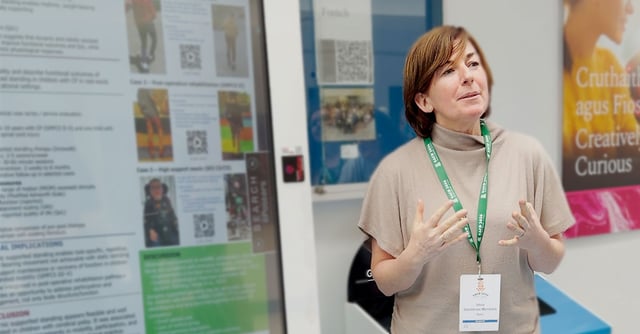
A poster presented at the European Academy of Childhood Disability (EACD) 2026 conference in Galway, Ireland, by Idoia Gandarias Mendieta from the Pitxuflitos Neurorehabilitation Clinic in Bilbao, Spain, explores exactly this — in a real-world paediatric clinical setting.
You can download the poster here.
Study overview: feasibility of dynamic standing in paediatric CP
Design and participants
This retrospective clinical case series evaluated the feasibility and functional outcomes of dynamic supported standing therapy in children with CP. Participants included:
- Children aged 5–18 years with CP (GMFCS levels II–V)
- One child with a high cervical spinal cord injury (C2/C3)
Intervention: Innowalk dynamic standing device
All participants used the Innowalk, a robotic-assisted standing device, with the following protocols:
- Frequency: 2–5 sessions per week
- Session duration: 30–60 minutes
- Total intervention period: 2 weeks to 6 months
- Post-operative follow-up in selected cases
Outcome measures
Clinicians tracked a range of outcomes, including:
- Passive range of motion (PROM)
- Spasticity (Modified Ashworth Scale)
- Bowel function
- Goal attainment scaling (GAS)
- Family-reported quality of life
Three clinical cases: dynamic standing in action
Case 1 — Functional decline following growth spurt (GMFCS III)
A 15-year-old adolescent with CP had lost independent mobility after a growth spurt. Following 5 sessions per week for 2 weeks in the Innowalk, outcomes included:
-
Improved lower limb passive range of motion
-
Improved endurance
-
Recovery of independent mobility
This case highlights the potential of intensive dynamic standing as an early intervention to prevent or reverse functional decline in ambulant children with CP.
Case 2 — Post-operative rehabilitation after achilles tenotomy (GMFCS II)
A 6-year-old child began using the Innowalk following Achilles tenotomy surgery. With 2 sessions per week over 6 months, outcomes included:
-
Improvement in gait pattern
-
Supported functional recovery
-
Progression towards greater independence
This case demonstrates how dynamic standing can be integrated into post-operative physiotherapy pathways for children with CP, supporting recovery in a safe, controlled way.
Case 3 — High support needs: spinal cord injury (C2/C3)
A 10-year-old with a complete cervical spinal cord injury using diaphragmatic pacing received 3 sessions per week for 6 months. Family-reported outcomes included:
-
Access to whole-body movement not otherwise possible
-
Increased engagement and participation
-
Improved self-esteem
This case is particularly significant — demonstrating that dynamic supported standing is not limited to children with CP, but may benefit any child with complex motor needs and high support requirements.
Clinical implications for paediatric physiotherapists and rehabilitation teams
This poster offers several important takeaways for clinicians working in paediatric disability, and neurorehabilitation settings:
- Dynamic standing enables movement that static standing frames cannot — providing repetitive, weight-bearing, task-specific input for children who cannot walk independently.
- It is relevant across a spectrum of diagnoses — from ambulant children with CP (GMFCS II–III) experiencing functional decline, to non-ambulant children (GMFCS IV–V) and those with spinal cord injuries.
- Post-operative integration is feasible — dynamic standing can be introduced as part of structured post-surgical rehabilitation, supporting recovery of function and gait.
- Participation and wellbeing matter, not just body function — family-reported improvements in engagement, self-esteem, and quality of life are meaningful clinical outcomes in their own right.
Limitations and next steps
The authors acknowledge important limitations: the small sample size, lack of a control group, heterogeneous population, and reliance on clinical and family-reported outcomes mean these findings should be interpreted with caution.
However, the conclusion is clear: dynamic supported standing is feasible and well accepted in children with cerebral palsy and complex motor needs. Further randomised controlled trials are needed to establish optimal dosing, long-term functional outcomes, and cost-effectiveness.
This article is based on a poster presented at the EACD 2026 conference: "Feasibility and Functional Outcomes of Dynamic Standing Therapy in Paediatric Cerebral Palsy" by Idoia Gandarias Mendieta, Pitxuflitos Neurorehabilitation Clinic, Bilbao, Spain.