

31 Oct 2023Innowalk Review: Wheelchair User Moritz Tests the Movement Trainer

Back to Blog Overview
Moritz Brückner is a tetraplegic, wheelchair user and guide for others with Spinal Cord Injury – and he took the time to test the Innowalk with us in person. Thoroughly. Honestly. What came out of it is more than a product test: it's a glimpse into what movement can mean for people with spinal cord injuries.
Guidzter is a German platform by and for wheelchair users. The so-called guides share everyday experiences, tips, tricks and product tests – from the only perspective that truly counts: their own. Moritz is one of them, and his journey from his home in the Allgäu region in Germany to us was a long one. All the more reason we're delighted he made the trip.
The full interview and video can be found directly on the Guidzter website.
Who Is Moritz Brückner?
Moritz Brückner is 24 years old, comes from the Allgäu region of Bavaria in Germany, and has been using a wheelchair since a surfing accident in Chile when he was 20 years old. His diagnosis: tetraplegia Sub C7 – a spinal cord injury below the 7th cervical vertebra. His legs are completely paralysed; he can flex and extend his arms, though his hand function is limited. His chest muscles are intact, but his back and abdominal muscles are absent.
What sets Moritz apart is that he refuses to let any of this hold him back. He leads an active, sporty life, shares his experiences on Guidzter, and motivates others in similar situations – with an openness and positive outlook on life that is truly infectious.
What Is a Spinal Cord Injury (SCI)?
A spinal cord injury – medically referred to as an SCI (Spinal Cord Injury) – is damage to the bundle of nerves within the spinal cord, which, as a central component of the nervous system, transmits signals between the brain and the body. The term encompasses both paraplegia (paralysis of the legs and trunk) and tetraplegia (paralysis of all four limbs), as in Moritz's case.
Common causes
- Traumatic: Road traffic accidents, falls, and sports injuries (like Moritz's surfing accident) are the leading cause
- Non-traumatic: Tumours, infections, inflammation, and degenerative conditions can also cause spinal cord damage
Complete versus incomplete spinal cord injury
- Complete: Below the level of injury, there is a total loss of sensation and motor function
- Incomplete: Some degree of sensation and motor function below the level of injury is preserved
Moritz has a complete tetraplegia Sub C7 – an injury pattern that places particular demands on assistive devices for rehabilitation and everyday movement.
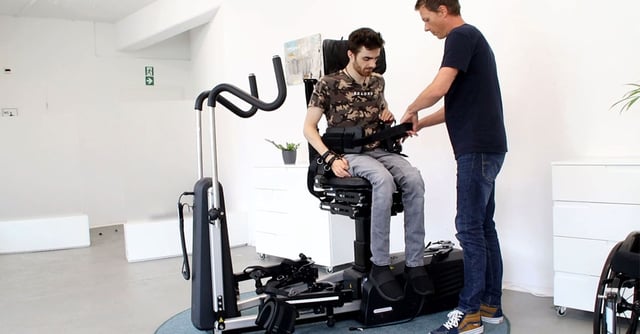
Moritz in the Innowalk — the practial test
Before getting started, Moritz puts a few questions to our physiotherapist and adviser Thomas Schwarze: Who is the Innowalk suitable for? What advantages does it offer over a standing frame? How does the transfer work? Moritz openly admits that he rarely uses his standing frame and leg movement trainer at home on a regular basis – and is immediately curious about the combination of both in a single device.
When he sees the Innowalk up close, his reaction is immediate:
"It looks like a proper cross-trainer!"
– Moritz Brückner
Once positioned, the motor-assisted movement begins – initially in a semi-standing position. Throughout the session, Moritz repeatedly feels spasticity in his legs. He remains calm and focused. The movement through his knees and hip flexors is visibly doing him good.
"And just like that, you feel athletic!"
– Moritz Brückner
Then comes the moment that goes beyond physiotherapy. Moritz realises that today, for the first time in four years, he is walking in a standing position. An unfamiliar, yet wonderful sensation. And an entirely new perspective on the world – quite literally.
"I can finally look down at people again!"
– Moritz Brückner
What is the Innowalk - and who is it suitable for?
The Innowalk is a dynamic movement trainer for children, young people and adults with significantly impaired standing and walking ability – developed for people who cannot perform active stepping movements on their own. It combines motor-assisted standing training with guided walking movement in a single device.
Assisted Movement
Motor-controlled, repetitive walking movement of the entire body – from a seated position through to an upright stance with weight-bearing.
Adjustable Support
Adjustable securing and support system for personalised positioning and exceptional comfort.
Spasme-control
The guided movement is automatically interrupted in the event of spasms – a crucial safety feature for people with spinal cord injuries.
Health benefits for SCI and tetraplegia
Clinical experience and growing research indicate that regular supported standing and guided walking movement can have meaningful benefits for people with spinal cord injuries, including:
- Circulation and cardiovascular health
- Respiratory function
- Digestion and bowel activity
- Muscle tone and spasticity management
- Bone density and joint mobility
- Psychological wellbeing through upright positioning
"In the end, you just have to try it for yourself. It's an experience you have to have."
– Moritz Brückner
We are truly delighted to have had the chance to meet Moritz – and to see just how much potential the Innowalk holds for him and all other wheelchair users. .
Frequently Asked Questions about the Innowalk
Who is the Innowalk suitable for?
The Innowalk is designed for children, young people, and adults who cannot stand or walk independently due to a neurological or neuromuscular condition — including spinal cord injury, cerebral palsy, multiple sclerosis, or stroke. No active muscle control is required to use it.
Can the Innowalk be used by people with tetraplegia?
Yes. As Moritz's review demonstrates, the Innowalk is suitable for users with tetraplegia. The adjustable support system and automatic spasticity pause make it safe and accessible even for complex injury profiles such as a complete SCI at C7.
How does the Innowalk differ from a standard standing frame?
A standing frame holds the body upright without movement. The Innowalk combines upright weight-bearing with motor-guided walking motion — actively promoting circulation, joint mobility, and muscle stimulation in a way a static standing frame cannot. For many users, it's also considerably more motivating to use regularly.
Is the Innowalk safe to use if I experience spasticity?
Yes. The Innowalk detects spasticity and automatically pauses the movement — a key safety feature for SCI users. Moritz experienced this during his session and was able to continue calmly once the episode passed. The system is designed to support, not override, the body.
How do I get access to an Innowalk — and is funding available?
The Innowalk is available through Made for Movement. Depending on your situation, funding through health insurance or care funding may be possible — particularly where there is a clear medical indication such as spinal cord injury or cerebral palsy. Get in touch with us and we'll help you navigate the application process.
This article was last updated 7th September 2026.