
27 Oct 2026 Going out with a wheelchair: concerts, clubs and carnival

Back to Blog Overview
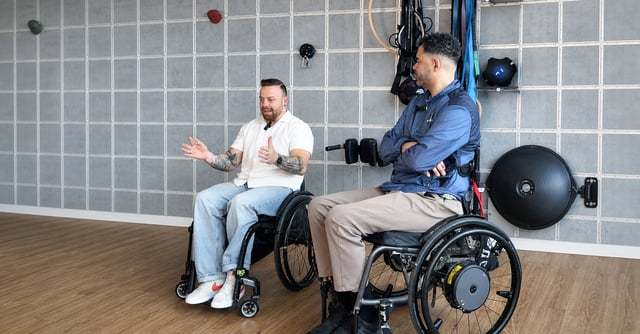
Going to a concert, a club or a carnival celebration in a wheelchair: is it even possible? Vera Krumm, Raymond Baafi and Lars Weber who all have a Spinal Cord Injury share what makes going out difficult, the role friends and assistive devices play, and why accessibility means far more than step-free access.
In this article you can read about:
- how people with spinal cord injuries experience concerts, clubs and carnival
- which physical and social barriers can make going out difficult
- how assistive devices and friends can support participation
- why accepting help does not contradict independence
- why accessibility involves more than step-free access
- why personal boundaries matter when celebrating
Going out with friends, listening to music, laughing together and simply being part of the action for a few hours. Going out is about far more than entertainment. It means community, belonging and the freedom to decide for yourself how to spend your free time.
After a spinal cord injury, the conditions for this can change. Steps, narrow spaces, a lack of lifts or a difficult journey can make it harder to attend an event. On top of that come the reactions of other people, which may be well meant but are not always helpful or respectful.
The experiences shared by our experts Vera Krumm, Raymond Baafi and Lars Weber who all have a Spinal Cord Injury show that going out with a wheelchair is possible. However, whether a concert or a night at a club is actually accessible and enjoyable depends on many factors.
Going to a concert in a wheelchair
Vera describes how positive a concert can feel as a wheelchair user. She went to a concert in her neighbourhood using her standing wheelchair. For almost two hours, she stood in it, listened to the music and spent the evening with friends and acquaintances.
“We just had so much fun. […] I felt completely normal and really enjoyed being part of the crowd and the concert.”
- Vera Krumm
What Vera valued most was that her spinal cord injury was not the focus during the concert. For that moment, she was simply a concert-goer and part of the crowd.
Her experience also shows how important assistive devices that meet individual needs can be. The standing wheelchair gave her a different position in the room and allowed her to experience the concert at eye level with the other guests. Accessibility is not only about being able to get into an event in the first place. It is also about being able to experience the event in a way that suits your own situation and personal needs.
Deciding for yourself when your disability is the topic
However, Vera’s evening also had another side. After the concert, two women asked her directly about her accident and told her the story of someone else with a spinal cord injury.
At that moment, she did not want to talk about paralysis, loss or the consequences of her accident. So she decided to walk away before the encounter could spoil what had been a wonderful evening.
This is also an important part of self-determination: people with disabilities have the right to decide for themselves when they want to talk about their story, their body or their limitations.
Carnival in a wheelchair: what friends can make possible
Ray talks about the day he celebrated carnival for the first time in several years (carnival is a yearly event in Germany). He describes his experience very openly:
“Celebrating carnival in a wheelchair in a club or a pub is an ordeal.”
- Raymond Baafi
Even so, he decided to go. The evening was made possible above all by friends and acquaintances who run a pub themselves. This meant Ray knew that conditions could be created on site that would allow him to take part. With the help of his wheelchair and orthoses, he was able to celebrate at eye level with others – quite literally.
“And that is something that is really, immensely valuable.”
- Raymond Baafi
His experience shows that a spinal cord injury does not always determine whether an activity is possible. Often, what matters is whether the environment is accessible, whether suitable assistive devices are available, and whether people are willing to find solutions together. Friends in particular can play an important role here – not by taking over everything, but by helping to create the conditions that make real participation possible.
Clubbing in a wheelchair: when attention becomes a barrier
Lars describes a different challenge of nightlife as a wheelchair user. In clubs, other guests approach him particularly often. Many want to high-five him, tell him what a cool guy he is, or deliberately strike up a conversation with him.
Much of this may well be meant in a friendly or appreciative way. But when alcohol is involved, personal boundaries are quickly crossed. Lars also talks about inappropriate jokes – such as the remark that people could just sit on his lap.
“And to be honest, it’s also pretty gross shaking hands with 200 people in one night at a club. It’s a nightmare.”
- Lars Weber
The constant attention means that Lars cannot simply enjoy his evening undisturbed. Sometimes his friends deliberately stand around him so that strangers don’t keep coming up to him and talking to him.
His experience shows that even well-meant attention can become a burden when a person is repeatedly reduced to their wheelchair. A venue can be physically accessible and still not feel inclusive.
Barriers often begin before the event
Whether an evening is a success is often decided on the journey there. Lars describes public transport as one of his biggest barriers. A broken lift or an unexpected gap in height between the train and the platform can suddenly mean that a journey is no longer possible independently.
With concerts, clubs and carnival in particular, the journey home is often late at night, when there are fewer alternatives. That is why an accessible event is not only about the entrance, but also about whether getting there and back is realistically manageable.
Not every wheelchair has the same requirements
Whether a venue is accessible in practice also depends on the type of wheelchair. Vera explains that her electric wheelchair gives her a lot of stability, an upright position and freedom of movement. At the same time, it is so heavy that it cannot simply be carried up or down steps on the spot. A lighter manual wheelchair would be more flexible in such situations, but would give her less physical support.
This shows that an event is not automatically equally accessible to all wheelchair users.
Staying flexible and having a plan B
Not every situation can be fully planned in advance. A lift may be out of order, an entrance may turn out to be less accessible than expected, or support may be needed at short notice.
For Vera, having a plan B is therefore part of what independence means to her. She does not want obstacles to stop her from doing things. At the same time, independence for her does not mean having to manage everything without help.
“It’s perfectly clear that you’re never independent. Even people without a spinal cord injury aren’t independent.”
- Vera Krumm
What matters more to Vera is doing what she can independently, making her own decisions and organising her everyday life so that she can achieve her goals, even with assistance or support.
Independence means freedom
Why are concerts, clubs, carnival and other events so important in the first place?
Because it is not just about music or entertainment. It is about friendships, shared memories and being able to decide for yourself how you want to spend your free time.
Ray sums up this idea perfectly in their conversation:
“Independence is freedom.”
For him, this freedom means getting out, meeting people, enjoying leisure activities and exploring the world – with or without support.
Going out with a wheelchair: possible, but not a given
Going out with a wheelchair is possible, even if barriers can make an evening more difficult. At the same time, the experiences shared in the conversation show what a difference suitable assistive devices, a supportive network and accessible venues can make.
The responsibility for participation must not rest solely with people with disabilities. Event organisers, transport operators and the owners of clubs, pubs and concert halls must also create conditions that enable people to take part as independently as possible. Flexibility can help when unexpected obstacles arise, but it is no substitute for a lack of accessibility.
When these conditions are in place, accessible events can once again deliver what they are really all about: shared experiences, belonging and joy.