

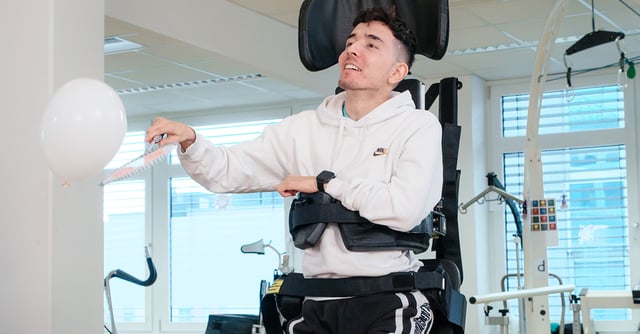
Dec 3, 2025 Advancing recovery: Salford Royal’s neuro team and the Innowalk Pro

Back to Blog Overview
Early movement after neurological injury is vital — yet often difficult to achieve. At Salford Royal Hospital, the neurorehabilitation team used the Innowalk Pro to make those first steps possible again, helping patients move sooner, build confidence, and rediscover hope in their recovery journey.
In this article you can read about:
- Reimagining early neurorehabilitation
- Real stories from clinical practice
- Shared outcomes - building strength, endurance, and hope
- Conclusion - movement makes a difference
Reimagining early neurorehabilitation
“Early movement after neurological injury is vital, but often extremely challenging,” explains Cath Sweby and Dawn Freilinger, Neurorehabilitation Physiotherapists at Salford Royal Hospital.
“The Innowalk Pro helps bridge that gap — enabling upright, supported movement when traditional methods aren’t yet possible. It hasn’t replaced therapy; it’s enhanced it, giving our patients confidence and a reason to re-engage with their recovery.”
Early mobilisation is often restricted by pain, fatigue, spasticity, or medical instability. The Innowalk Pro, a robotic-assisted dynamic standing device, helps overcome these barriers. It enables supported weight-bearing and rhythmic, cycling-like movement, allowing patients to safely activate key muscle groups, rebuild confidence, and take part in therapy earlier than might otherwise be possible.
“The Innowalk Pro was used as part of our toolkit for engaging patients who might otherwise struggle to participate,” says Cath.
“It’s not replacing therapy — it’s enabling it.”
Salford Royal Hospital
Salford Care Organisation (part of the Northern Care Alliance) provides comprehensive rehabilitation services, focusing on getting patients home safely through dedicated facilities like the purpose-built Bevan Unit for Intermediate Care and the Stroke Rehabilitation Unit (SRU), offering therapy (physio, OT, speech) in hospital and community settings to regain independence. They utilise a multidisciplinary approach, including home-based support and community links, aiming for integrated health and social care for better outcome .
Real Stories from clinical practice
Every patient’s journey with neurological injury is unique — but a common challenge is finding safe, meaningful ways to move early in rehabilitation. The following case examples illustrate how supported, repetitive movement has helped patients overcome barriers, rebuild strength, and re-engage with therapy in transformative ways.
Case 1 – Finding comfort in movement again
Patient description
19-year-old male, post-cardiac arrest and encephalopathy. After months of distress and pain with any handling or limb movement due to significant spasticity, rehabilitation progress had plateaued. Traditional therapy caused discomfort and anxiety. Positioning was becoming extremely difficult in bed and bespoke specialist seating was required, but not well tolerated.
Intervention
Two five-week Innowalk Pro trials introduced upright, supported movement in a pain-free and controlled environment, allowing gradual reintroduction to therapeutic activity.
Key outcomes
- Pain reduced from 8/10 → 0/10 on a numeric reference scale
- Sitting tolerance improved from minutes to 3+ hours
- Gained independent rolling and transfer practice
- Improved concentration and emotional stability
Therapist reflection
The Innowalk Pro transformed therapy from something feared by the patient into something actively enjoyed. A crucial emotional turning point that renewed the patient’s trust in movement and recovery.
Case 2 - Rebuilding confidence after stroke
Patient description
56-year-old male with right-sided weakness and sensory neglect following a stroke. Initially unable to tolerate handling or maintain posture, he struggled to engage in rehabilitation activities.
Intervention
Over seven weeks (13 sessions), the Innowalk Pro was incorporated into therapy, providing repetitive, supported movement that promoted postural alignment and endurance while reducing fear of movement.
Key outcomes
- Therapy tolerance increased from 10 → 80 minutes
- Pain reduced from 10/10 → 2/10 on a numeric reference scale
- Improved hip and knee range of motion
- Progressed from hoist to sliding board transfers
- Renewed engagement in therapy and family life
Therapist reflection
Once movement became achievable and safe, motivation and participation improved dramatically — highlighting the link between early mobility and psychological engagement in recovery.
Case 3 - Strength and balance restored through repetition
Patient description
41-year-old male with left hemiplegia following a right hemisphere haemorrhage. Presented with significant spasticity, fatigue, and reduced trunk control.
Intervention
A four-week Innowalk Pro programme (12 sessions) focused on endurance, trunk stability, and motor recovery through supported, repetitive movement.
Key outcomes
- Reduced spasticity in hips, knees, elbows, and wrists (Modified Asworth Scale)
- Muscle power gains: hip abduction 0→3, knee flexion 0→3
- Trunk Impairment Scale: 7/16 → 13/16
- Fatigue: 13 → 1 (Daily Fatigue Impact Scale)
- Endurance: 15 → 30 minutes per session
- Moved from hoist to sliding board transfers and supportive to standard wheelchair
Therapist reflection
Each session seemed to “switch on” dormant muscle activity — creating both physical and psychological momentum that carried over into daily therapy and self-initiated movement.
Case 4 - Regaining independence at 85
Patient description
85-year-old female in stroke rehabilitation, presenting with severe fatigue, reduced trunk control, and limited sitting balance. Despite these challenges, she was highly motivated to regain independence.
Intervention
Seventeen Innowalk Pro sessions over four weeks focused on supported movement, trunk activation, and stamina building to complement traditional therapy.
Key outcomes
- Hip and knee strength: 2→3
- Trunk control: 4/16 → 13/16
- Stamina: 7 → 20 minutes per session
- Borg scale: 15 → 11
- Progressed from airflow to foam mattress
- Moved from hoist to sliding board transfers
- Improved sitting balance and wheelchair independence
Therapist reflection
Gradual, visible progress reignited her confidence, motivation, and sense of independence — proving that meaningful gains are possible at any age with the right support and movement strategy.
Shared outcomes - building strength, endurance, and hope
Across all four cases, the Innowalk Pro proved to be more than just an assistive device — it became a turning point in each patient’s recovery journey. For individuals who had reached a plateau with conventional therapy, it offered a new way to move, engage, and progress.
The consistent theme was clear: movement leads to momentum. Patients showed measurable improvements not only in physical function but also in motivation, confidence, and overall participation in rehabilitation.
Clinical Insights
The Salford Royal neurorehabilitation team noted consistent therapeutic benefits that translated directly into meaningful gains:
|
Observed Benefit |
Clinical Implication |
|
Reduced spasticity and pain |
Greater comfort and willingness to engage |
|
Strength and trunk control improvements |
Better sitting balance and transfers |
|
Increased stamina and reduced fatigue |
Longer, more productive therapy sessions |
|
Enhanced participation and mood |
Stronger engagement in rehabilitation goals |
|
Greater independence |
Earlier progression toward discharge readiness |
|
Safe environment building confidence and motivation |
Reduced the number of staff needed to provide effective treatments. |
Conclusion - movement makes a difference
The Salford Royal neurorehabilitation team have shown that even in the most complex neurological cases, early standing and return to movement after long periods of immobility are both possible and powerful. By integrating the Innowalk Pro into therapy, they’ve created new opportunities for patients to move, build strength, and rediscover control over their recovery.
The results highlight how robotic-assisted movement complements hands-on physiotherapy, enabling earlier engagement, measurable improvement, and renewed hope.
The Salford Royal team has also shared their findings through three conference posters presented at MiNT 2025. You can download them here:
- Efficacy for use of Innowalk Pro in Hyperacute Neurorehabilitation Setting Single Patient Case Study
- The Impact of the Innowalk Pro on Patient Orientated Goals Hyperacute Neurorehabilitation - Case Study
- The Impact of the Innowalk Pro 2 on Hemiplegia Post Stroke, Stroke Rehabilitation Unit