

Oct 12, 2026Innowalk Pro, Frame Running & Paralympic Dreams: Finn's Story

Back to Blog Overview
From Dublin to the global stage, Finn’s story shows what becomes possible when cerebral palsy rehabilitation technology and the right sport come together. At just 17, Finn - who has quadriplegic cerebral palsy - is training toward the Paralympic Games while balancing school, recovery, and daily life in Dublin.
At the centre of his rehabilitation is the Innowalk Pro, a motorised dynamic standing device from Made for Movement. Designed for people with limited mobility, the Innowalk Pro has supported Finn through not one but two surgeries - including a full spinal fusion in December 2024 - helping him return to movement faster and maintain activity year-round.
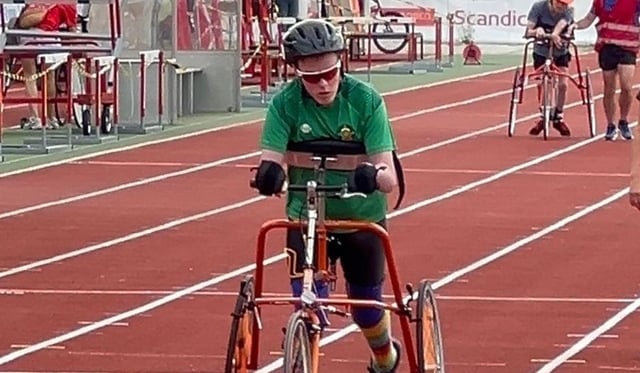
Finn also competes in frame running, an adaptive sport for wheelchair users set to debut at the Los Angeles 2028 Paralympics. His journey is a powerful example of how the right assistive technology for cerebral palsy, paired with determination and a demanding sport, can unlock extraordinary potential.
“I’d describe myself as determined, competitive, positive, and driven,” Finn says.
In this article, you can read about:
- Cerebral palsy, assistive technology & daily independence
- Finding the right adaptive sport for quadriplegic cerebral palsy
- Discovering frame running: an adaptive sport for wheelchair users
- Building access to frame running in Ireland
- From local training to international frame running competition
- Innowalk Pro for spinal surgery rehabilitation
- Aiming for the Paralympic Games: Frame Running Los Angeles 2028 & Brisbane 2032
- Beyond sport: inclusion, accessibility and independence
Cerebral palsy, assistive technology & daily independence
Finn attends mainstream school at Templeogue College, where he is currently in fifth year. His days are busy and structured, starting early each morning. "My parents help me get up and ready for school, and I’m usually finished by mid-afternoon. After that, I’ll do some homework and then try to do something active," Finn says.
That might mean heading out for a frame run around his local estate or getting outside for a walk. Weekends are just as busy, with drama activities and swimming sessions forming part of his routine. Staying active isn’t just a hobby—it’s a key part of how Finn experiences independence and wellbeing.
Finding the right adaptive sport for quadriplegic cerebral palsy
Sport has always been important to Finn, but finding the right one took time. "Because I mainly use an electric wheelchair, I tried a lot of different wheelchair sports over the years—both manual and powerchair sports. They were good to try, but I never really felt like I had found my sport,” Finn explains. What Finn was looking for was something more physically demanding.
“I love getting out of breath. I wanted something where I really felt like I was pushing myself.”
Discovering frame running: an adaptive sport for wheelchair users
Finn first discovered frame running in Perth, Scotland, after being encouraged by a friend. This introduction marked a turning point, as Finn had spent years searching for an activity that provided a genuine sense of challenge and fulfilment. While he had tried various wheelchair sports, none had offered the physical intensity or excitement he craved. Frame running, however, was different—it was dynamic, demanding, and truly engaging.
“She described it as a three-wheeled running bike with no pedals—you run to propel yourself. I knew I had to try it.”
Frame running is a Paralympic-recognised adaptive sport for athletes with neurological or physical impairments who cannot run unaided and is scheduled to debut at the Los Angeles 2028 Paralympic Games.
At the time, there were no frame running clubs in Ireland. Finn and his family travelled to London to try it for the first time. The anticipation and excitement of finally experiencing frame running was immense. For Finn, this wasn’t merely another attempt at sport—it was the hope of discovering something that could offer both physical freedom and personal joy. “We ordered a frame runner the very next day,” Finn says.
The experience was transformative. From the moment Finn took his first strides, he realised he had found something truly special. It wasn’t just about the novelty or the thrill—it was a sense of liberation, a way to move and challenge himself in ways he hadn’t before. Frame running allowed Finn to feel the rush of movement, the satisfaction of exertion, and the pride of achieving something new.
“I had never really run before. That was the first time I felt like I was allowed to run. I could go fast, get out of breath, and really push myself.”
Finn’s journey to frame running was not just about finding a sport; it was about discovering a passion that gave him a profound sense of belonging and possibility. After years of searching and experimenting, he had finally uncovered an activity that met his desire for intensity and independence. Frame running became more than a pastime—it was a source of joy, confidence, and genuine love, transforming Finn’s outlook on sport and movement.
Building access to frame running in Ireland
Frame running in Ireland is still an emerging sport, with limited clubs and coaching pathways compared to the UK or Scandinavia. Finn is passionate about changing that. He hopes to see more local clubs, coaching support, and pathways for young athletes to get involved in the sport.
Moments like the EACD 2026 conference in Galway are an important step in that direction. From 3–6 June, frame running was featured in the Experience Village, giving children and families the chance to see the sport up close and take part in dedicated sessions. It’s an opportunity for more young people - like Finn once was - to discover the confidence, movement and joy that frame running can bring, and to help build momentum for the sport’s future across Ireland.
From local training to international frame running competition
With limited competition opportunities locally, Finn’s early races were few and far between. Finn explains: "At one event, there was just one other frame runner. That’s when it clicked—I didn’t just want to be the fastest in Ireland. I wanted to test myself properly." That ambition took him to Copenhagen for the Frame Running World Championships and Development Camp. He continues: "It was a huge reality check. I thought I was fast—but I was one of the slowest there." Instead of discouraging him, the experience fuelled his motivation.
“I trained harder, came back the following year, and things changed.”
Finn has since achieved remarkable success, winning four medals – two gold and two silver on his most recent visit to Copenhagen.
Innowalk Pro for spinal surgery rehabilitation
Finn’s journey hasn’t just been about performance - it has also involved significant medical interventions and rehabilitation along the way.
At the age of seven, he underwent Selective Dorsal Rhizotomy (SDR) surgery. More recently, in 2023, he had a smaller spinal fusion to address changes in his spine. Following a year review, it became clear that his scoliosis had progressed significantly, and in December 2024, Finn underwent a full spinal fusion.
Recovery from this type of surgery can be both physically and mentally demanding. For Finn, getting back into movement as early as possible was a key priority.
“Within two weeks of getting out of hospital, I was back in the Innowalk doing rehab.”
The Innowalk Pro has played an important role in his rehabilitation - supporting him through not just one, but two recovery periods.
The Innowalk Pro is a motorised dynamic standing frame designed for people with limited mobility, including those with cerebral palsy, spinal cord injuries, and neurological conditions. By providing fully assisted, repetitive walking movements in an upright, weight-bearing position, it enables users to experience supported gait training even when independent walking is not possible.
For Finn, this meant he could begin moving again early in his recovery, without placing unsafe strain on his body.
“It helped me recover not once, but twice.”
The device’s robotic, guided movement creates a consistent and controlled walking pattern, which can be especially valuable after surgery. This type of supported training helps to maintain joint mobility, stimulate circulation, and reintroduce movement in a safe and structured way. Just as importantly, it offers a way to stay active during periods when traditional training isn’t possible.
Even now, the Innowalk Pro remains part of Finn’s routine—particularly during the winter months when outdoor frame running is limited.
“Movement is hugely important to me. I like feeling like I’ve worked hard and done something positive for my health and wellbeing.”
For Finn, movement is more than training—it’s a vital part of recovery, independence, and maintaining both physical and mental wellbeing.
Aiming for the Paralympic Games: Frame Running Los Angeles 2028 & Brisbane 2032
Finn’s long-term goal is clear: to represent Ireland at the Paralympic Games. Frame running is set to debut at the Los Angeles 2028 Paralympics, although currently only one classification is included. Finn explains: “I compete in T71, which isn’t part of the programme yet. My hope is that by Brisbane 2032, it will be included.”
With the 100 metres as his strongest event, Finn is focused on continuing to improve and be ready when the opportunity comes. Beyond his own ambitions, he is also encouraged by the growing visibility of frame running worldwide, as more athletes take up the sport and push for broader inclusion across classifications. For Finn, it’s not just about personal success—it’s about helping to build momentum for the sport so that future athletes have even greater opportunities on the Paralympic stage.
Beyond sport: inclusion, accessibility and independence
Alongside his sporting ambitions, Finn has big plans for the future. He hopes to attend university and pursue a career in music as a DJ and producer under the name Spinn Dempsey. "I’d love to open Dublin’s first fully disability-inclusive nightclub," says Finn. For Finn, inclusion means more than just access.
“A lot of places say they’re accessible, but once you’re inside, they don’t really consider your experience.”
His vision is a space designed for everyone—from wheelchair users to people with sensory sensitivities and hearing impairments. From thoughtful layout and sound design to lighting and staff awareness, every detail would be shaped around creating a genuinely welcoming environment.
“I want it to be a place where everyone can properly experience a night out.”
Ultimately, Finn’s goal is to challenge what inclusion looks like in everyday life, creating spaces where accessibility is not an afterthought but a starting point, and where independence, dignity and enjoyment are built into the experience for everyone who walks through the door.
We would like to extend our heartfelt thanks to Finn for sharing his inspiring journey and insights. Wishing him the very best of luck as he pursues his Paralympic dreams and brings his vision of a truly inclusive nightclub in Dublin to life. His dedication and ambition are sure to make a lasting impact on both sport and society.
FAQ
What is the Innowalk Pro and who is it for?
The Innowalk Pro is a compact end-effector device, delivering comprehensive robotic therapy. It provides fully assisted, repetitive walking movements in an upright, weight-bearing position — supporting people with limited mobility, including those with cerebral palsy, spinal cord injuries, and other neurological conditions. The Innowalk Pro is especially designed for multiple use in clinics and hospital settings, rehabilitation centers, therapy facilities, or special school settings. Individual suitability and use of the Innowalk Pro should always be assessed and justified by a qualified healthcare professional.
Is frame running in the Paralympic Games?
Frame running is set to make its Paralympic debut at the Los Angeles 2028 Games. Currently only certain classifications are included in the programme; Finn competes in T71 and hopes T71 will be added by Brisbane 2032.
Can the Innowalk Pro help with recovery after spinal fusion?
Yes - Finn returned to the Innowalk Pro within two weeks of leaving hospital after full spinal fusion surgery in 2024. The device's guided, motorised motion allows safe weight-bearing movement during recovery, without placing strain on the surgical site. Individual suitability and timing of Innowalk Pro use during post-surgical rehabilitation should always be assessed and approved by a qualified healthcare professional.
What adaptive sports are available for people with cerebral palsy?
People with cerebral palsy participate in a wide range of adaptive sports - including frame running, boccia, wheelchair racing, swimming, powerchair football, and athletics. Frame running in particular is suited to athletes with lower limb involvement who cannot run unaided.