

Jan 31, 2019 | Last updated: Oct 23, 2026Paralyzed from the neck down: How Samuel Koch exercises with tetraplegia

Back to Blog Overview
Samuel Koch, a former stuntman and now an actor, was left paralyzed from the neck down after a spinal cord injury in a failed attempt at jumping over moving cars – live on the German TV show “Wetten, dass..?”. Since the 2010 accident, Samuel has lived with tetraplegia (also called quadriplegia) and relies on assistance with practically everything. Still, he remains a highly active person – and even manages to get intense, daily exercise in the Innowalk.
A spinal cord injury live on TV
Samuel was one of the candidates on Wetten, dass..?, one of Europe’s top-rated TV shows at the time. The German TV format let viewers bet on different stunts, and Samuel was performing probably one of the riskier ones in the show’s history.
“I had been doing that jump so often that I almost knew it in my sleep”, writes Koch in his biography Zwei Leben (Two Lives). However, millions of live viewers were unsuspecting witnesses when the stunt went terribly wrong. Wearing ‘kangaroo’ spring stilts, Samuel successfully cleared the first three cars, but got caught by the fourth and crashed to the floor. The fall caused a high-level (cervical) spinal cord injury, leaving him with tetraplegia.
Life with tetraplegia: staying active as an actor
Despite the life-changing accident, Samuel has retrieved his sense of humour and looks at life in a positive way. He went back to studying acting and now stars in theatre productions, TV series and films.
His work requires him to be in good shape, and as a former athlete, Samuel has tried a number of different therapies and training devices for people with spinal cord injury to find the right one.
“I searched for many years, actually six-seven years, for something that could stimulate my cardiovascular system and make me feel exhausted after a training session”, says Samuel.
“I have never used a device that provides such an intensive training of my body – I’m actually out of breath. What a feeling!”
– Samuel Koch, actor
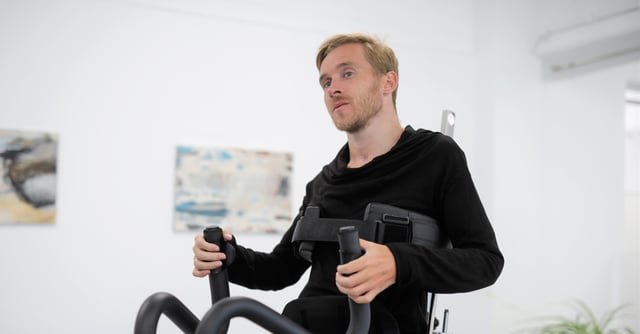
In the video, Samuel Koch, who has tetraplegia after a spinal cord injury, shows how he exercises in the Innowalk and explains why upright movement with weight-bearing makes such a difference to him.
Why exercise matters after a spinal cord injury
After a spinal cord injury, many people spend most of the day sitting in a wheelchair. Long periods of sitting and limited movement are linked to a number of secondary health problems, such as reduced cardiovascular fitness, loss of bone density, increased spasticity, poor circulation and digestive issues.
For people with tetraplegia, finding a way to exercise can be especially challenging, because the arms and hands are also affected. Regular, physical activity – adapted to the individual and planned together with a physiotherapist – is an important part of spinal cord injury rehabilitation and of staying healthy in the long term.
Finding a standing frame that actually challenges him
At a rehabilitation clinic in Cologne, Samuel was introduced to the Innowalk Pro. He and his family were impressed by how its simplicity and functionality made it a highly efficient device. Together with his physiotherapist, he now exercises daily in the Innowalk at home, and he can really feel the effect of being in upright, standing movement.
“The Innowalk makes me move three-dimensionally in all directions in a way that actually leaves me short of breath. In addition to the fact that I get full weight-bearing on my bones, the ankles, knee joints and hip joints, I always feel really invigorated afterwards. Another advantage is that it is super compact compared to many other gait trainers and other assistive devices, making it ideal for home use”, he continues.
“I now combine 3-4 training devices in one, and it’s such a great feeling that I use the Innowalk between 2-6 hours a day while doing other things. I’ve found exactly what I need”, Samuel concludes with a smile.
Read more: Moritz tests the Innowalk – a wheelchair user with a spinal cord injury
The benefits of dynamic standing and weight-bearing
A traditional standing frame holds the body upright in a static position. The Innowalk is a dynamic standing device: it supports the user in a weight-bearing, upright position while guiding the legs through repetitive, walking-like movements. This combines the benefits of standing with active-assisted movement.
For people with a spinal cord injury, the reported benefits of standing and moving include:
- Weight-bearing through the hips, knees and ankles, which is important for bone health
- Movement of the joints, which can help maintain range of motion
- Stimulation of the heart, lungs and circulation
- A break from sitting, and a different perspective on the world
- Increased energy and wellbeing – as Samuel describes it, feeling “really invigorated”
Because the Innowalk is compact, it can be used at home, making it easier to exercise regularly.
Read more: Wenche Was Locked Inside Her Body at 39 – This Is Her Journey Towards a Better Life
FAQ: Exercise and standing with tetraplegia
Can people with tetraplegia exercise?
Yes. Even with limited or no voluntary movement in the arms and legs, people with tetraplegia can exercise using assisted and adapted equipment, such as dynamic standing frames, FES cycling or passive and active-assisted movement trainers. The right type of exercise should be planned together with a physiotherapist.
What are the benefits of a standing frame for adults?
A standing frame lets adults who cannot stand independently get into an upright, weight-bearing position. A dynamic standing frame like the Innowalk also adds movement, which can stimulate the cardiovascular system, support joint mobility and give a welcome break from sitting.
How long should you use a standing frame each day?
This varies from person to person and should be agreed with a physiotherapist. Samuel Koch uses the Innowalk between 2 and 6 hours a day, often while doing other activities at the same time.
Can a dynamic standing device be used at home?
Yes. The Innowalk is compact enough for home use, which makes it easier to make daily exercise part of the routine – as Samuel does.