

Feb 20, 2026 | Last updated: Sep 10, 2026What is the GMFCS, and why is it used?

Rikke Damkjær Moen - Physiotherapist and Medical Manager
Back to Blog Overview
6:56
The Gross Motor Function Classification System (GMFCS) for children with Cerebral Palsy (CP), is a widely used tool that helps healthcare professionals describe a child’s typical mobility in everyday life, such as how they sit, stand, walk, and whether they use mobility aids. The GMFCS reflects what the child usually does day to day.
In this article you can read about:
- What is GMFCS?
- What does the GMFCS level (I-V) mean?
- How does age matter in GMFCS?
- Who decides my child’s GMFCS level?
- Can a GMFCS level change over time?
- Why is the GMFCS used?
- Is GMFCS the same as GMFM?
- Does a higher GMFCS level mean therapy won’t help?
What is GMFCS?
GMFCS stands for Gross Motor Function Classification System and is a classification for children with Cerebral Palsy (CP). It is a tool used by healthcare professionals to describe your child’s current, typical mobility, and what your child usually does in everyday life. It focuses on:
- Sitting
- Standing
- Walking
- Use of mobility aids (if needed)
The GMFCS does not measure intelligence, effort, or potential. It is only about gross motor movement.
GMFCS is translated into several languages. You can find them here.
What does the GMFCS level (I-V) mean?
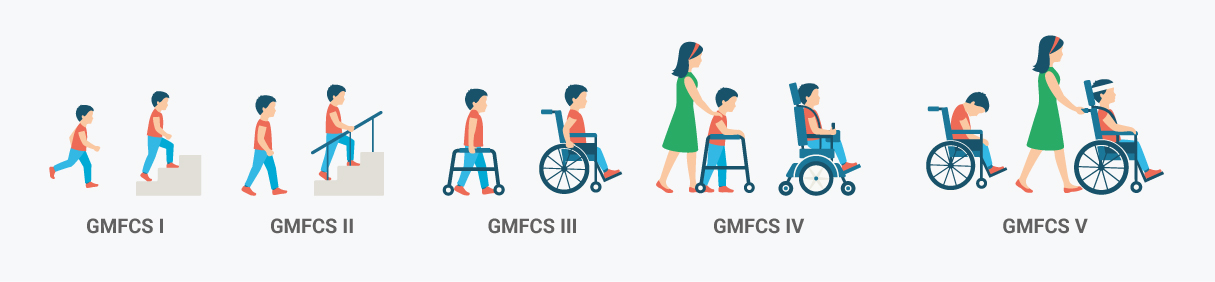
GMFCS has five levels, based on typical day-to-day movement. The general headings for each level are based on the mobility most characteristic for children after six years of age:
- Level I – Walks without limitations
- Level II – Walks with some limitations (e.g. difficulty with long distances or uneven ground)
- Level III – Walks using a walker, crutches, or similar device
- Level IV – Limited self-mobility; often uses powered mobility
- Level V – Very limited voluntary movement; relies on caregiver assistance and wheelchair mobility
Importantly, the levels describe what your child usually does, not their best day or worst day.
How does age matter in GMFCS?
The GMFCS uses age bands, because movement naturally changes as children grow. Your child is always compared to other children of the same age, not to older or younger kids.
The age bands are:
- Under 2 years
- 2–4 years
- 4–6 years
- 6–12 years
- 12–18 years
For example, a GMFCS Level II toddler and a GMFCS Level II teenager will look very different and that’s expected. The level stays the same, but the description changes with age to reflect what is typical at that stage of development.
Who decides my child’s GMFCS level?
GMFCS levels are usually assigned by a doctor and physiotherapist, based on how your child moves in everyday life. But parents can also play an important role in this process.
There is a questionnaire made specifically for families called the GMFCS Family and Self-Report Questionnaire. It is available in several languages and can be accessed through CanChild. This questionnaire is available for four age groups:
- 2–4 years
- 4–6 years
- 6–12 years
- 12–18 years
This questionnaire helps parents describe their child’s typical mobility at home, at school, and out in the community — in other words, the real day-to-day picture.
Studies have shown that parents are often very accurate when using this questionnaire to identify their child’s GMFCS level. That’s why involving parents can be extremely valuable for healthcare professionals who want the most realistic and complete understanding of a child’s motor abilities.
Can a GMFCS level change over time?
The GMFCS is designed to classify severity and not to measure small changes in function as a result of therapy. To determine change of function Gross Motor Function Measurement (GMFM-66) is typically used.
Th GMFCS levels have shown to be quite stable after age 2, and most children (72-84%) do not change their level. Looking at the precents you can see that some might change. This change most commonly happens between the age of 2-4.
Why is the GMFCS used?
You might be wondering why doctors and therapists use GMFCS in the first place.
One of the main reasons is that it provides a clear and reliable description of how your child moves in everyday life. Over time, it has also proven helpful in giving a general idea of how motor skills may develop as a child grows.
Because the five GMFCS levels are clearly described and relatively easy to distinguish, the system is widely used to support planning and decision-making. It can help professionals:
- plan therapy and intervention goals
- understand what support a child may need at school or in the community
- consider whether mobility aids such as crutches, walking frames, gait trainers or a wheelchair might be helpful now or in the future
This does not mean that your child’s future is decided by a GMFCS level. Instead, GMFCS is simply one useful tool that helps professionals and families plan realistically and supportively.
GMFCS is also used in research. It helps researchers describe groups of children accurately and understand the wide range of movement abilities within cerebral palsy. Even children with the same diagnosis can have very different physical abilities, and GMFCS provides a clear way of describing those differences.
Is GMFCS the same as GMFM?
No GMFCS and GMFM is two different tools:
- GMFCS = a classification (which level best describes everyday mobility)
- GMFM (Gross Motor Function Measure) = a test that measures changes in motor skills over time.
In simple terms:
- GMFCS answers “Which level fits best?”
- GMFM answers “What skills are changing?”
Does a higher GMFCS level mean therapy won’t help?
A higher GMFCS level does not mean therapy is less important or less effective. It simply means your child may need different kinds of support.
Therapy can help with:
- Comfort – reducing pain, preventing stiffness and supporting healthy positioning
- Participation – making it easier for your child to participate in activities at home, at school and in the community
- Independence – supporting your child to do as much as possible for themselves
- Energy efficiency – helping movement feel easier and less tiring
- Access to play, school and social life – finding the right equipment or strategies so your child can take part alongside their peers
At some GMFCS levels, therapy may focus more on developing walking skills. At other levels, it may focus on safe transfers, powered mobility, posture, communication, or making daily routines smoother and more comfortable.
Progress does not always mean “moving up a level”. Progress can mean:
- Sitting more comfortably for longer
- Using a powered wheelchair independently
- Having more stamina during the school day
- Playing in a way that feels joyful and included
The goals may look different at different GMFCS levels, but therapy can be meaningful, valuable and life-enhancing at every level.
Most importantly, therapy is not about changing who your child is — it is about helping them live their life as fully and comfortably as possible.